Can AI tell a push-in from a pull-out?
Not reliably. I found out by asking AI models to describe my reference films, so I built a Mac app that measures the camera from the pixels instead.
To remake a shot with AI you need its grammar: the camera move, the speed, the lens, the light, what the actor does and when. I study references for every film, and describing them by eye is slow. So I started asking AI models to describe them for me.
Can AI models read camera movement?
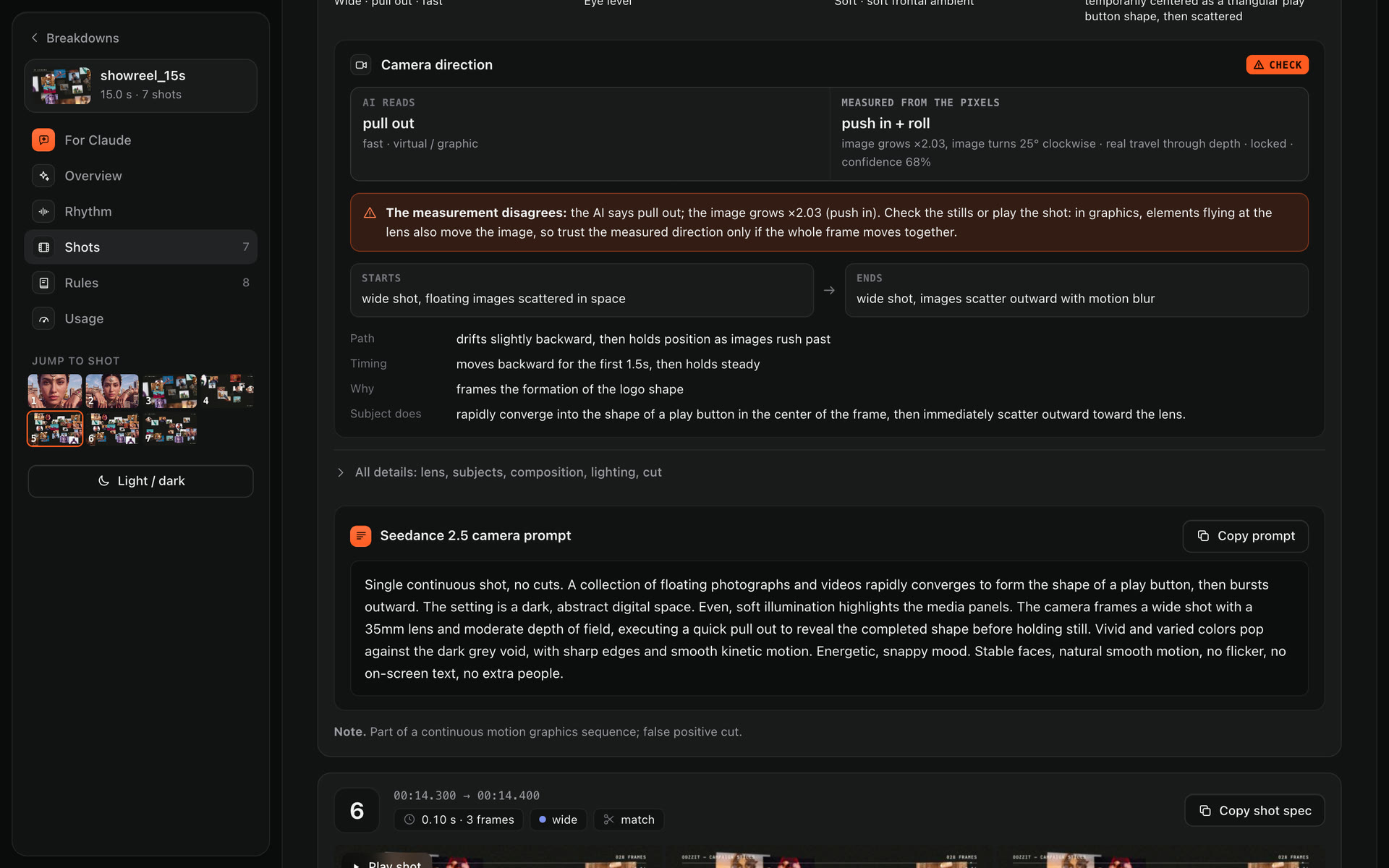
They describe what's in a frame well. Camera movement is about the change between frames, and that's where they slip, in confident language. On one shot from a 15-second showreel I analysed, the AI said "pull out". Measured from the pixels, the image grows 2.03 times and turns 25 degrees: a push in with a roll. In graphics shots, things flying at the lens fool it even more.
Why not just trust the AI's description?
Because it doesn't only happen with cameras. When I asked Gemini to log a 95-second Bhakti reel second by second, it put all the narration inside the first 72 seconds and called the rest silence. The voice ran right to the end. The lesson I keep re-learning: check an AI's answer against something measured from the file before you trust it.
How does Shot Breakdown work?
- It finds every cut, timed to the frame, and pulls the first, middle and last still of each shot.
- It measures camera motion with optical flow and reads the sound from the waveform: tempo, cuts on hits, silences.
- It asks the AI engine you choose to describe each shot. Gemini watches the video with sound; Claude Code, Codex and local models read the frames.
- Where the AI and the measurement disagree, it flags the shot.
- It writes two prompts per shot, one for the camera and one for the performance, plus a brief Claude turns into Seedance prompts.
It runs on your Mac with your own AI key. Nothing is sent to me.
Does the measurement always win?
No. In graphics, flying elements move the image too, so the measurement can be fooled as well. The app shows you both readings and the stills, and you make the call. That's deliberate: the tool's job is to stop you trusting a confident sentence, not to replace your eye.